Monday, July 09, 2012

The Best Drawings or Paintings

stream in the woods
Usually the best drawings or paintings seem almost to draw or paint themselves. They pour out smoothly onto the paper and seem to fall into place. Pastel colors blend beautifully, the textures work together and there is a landscape or still life that has really come to life on the page. But this state of affairs is a culmination of a lengthy period of learning, trial and error, or   in other words, the best art is usually the result of a lot of frustrating failures that went before. I think one learns the most from the disasters, not the triumphs. The disasters tend to far out number the triumphs too, at least in my experience as a fine artist. So you could say, I'm able to learn a lot and often, but it's all worth it when a wonderful piece of art is sometimes the gratifying result!

What is your experience getting to the best in your work or your art? Was it worth the effort? Did you learn something?

Tuesday, July 03, 2012

The Need to Simplify or Abstract Art


Marble Quarry Pastel Landscape by Paul Creedon
Marble Quarry Pastel Landscape by Paul Creedon.
As a pastel artist I find that the most formidable challenge in the visual arts is the need to simplify (or abstract) the appearance of the object I intend to paint with my pastels or draw with sanguine chalks. My artist's instincts seem to resist the idea of leaving out some of what I see when I compose a new still life or create a landscape. But given my years of experience and training I know that I must in order to arrive at a better picture.

And it will be a better picture. That is because a lot of extraneous stuff will be left out that would only confuse the viewer and art lover. Even if they are someone who is used to looking at fine art. Knowing what to leave out also helps to convey the one major thought that I want a person to see and come away with. Perhaps it's the roundness of a fruit in a pastel still life or the light coming through the trees in a landscape drawing.  Either way I know the picture is enhanced when there are fewer distractions.

To see more of my pastel art and to make a purchase contact Patricia Creedon at 

Wednesday, April 18, 2012

Is it Done Yet?

Of course, giving up on a thing when you’re sick of it isn’t always the best way to decide it’s done. My solution: put the artwork in the closet and forget about it for a while. When enough time has passed I go and look at it, and the question of whether the piece is finished very quickly answers itself.

I’ve discovered another advantage to this approach. Sometimes I know I should redo some section of a painting, but I decide against it because I am just too tired to tackle it, and want to get on with another project. Put the problem away for a month or two, and I find that I again have the energy to fix whatever needs to be fixed.

Titian used to start a painting, rough it in over a couple of days, turn it against a wall and leave it for a few months before taking it up again. I think he must have been using the same principle I use when I put things in that dark closet and forget about them for a bit. At any rate, his idea might be a first cousin to mine, although I give him credit for having thought of it first.
Problem Solving in Art

Squinting must be one of humanity’s greatest inventions. When I am at a loss about what to do with an unusually obdurate painting, I look at it and squint. Once my headache clears up, I’ve gotten a start on what needs to be simplified or changed.

Maybe this works for me because I give my brain a nice problem: what has to be edited out of a scene so that enough of it remains for the mind to make sense of it? Theoretically the optic nerve is impartial, so I can depend on its decisions.

Another recommended method of determining what’s wrong with a piece that just isn’t cooperating, is to look at it upside down. Frankly this one has never worked that well for me. Still, if some line I’ve convinced myself is ramrod straight just happens not to be so straight, the upside down trick will usually deliver the bad news.

Supposedly, one of the premier challenges for the artist is to know when to stop working on his piece of art. I generally stop when I’m sick of the thing.

Wednesday, April 11, 2012


Art & Soul.

It does seem strange; to get a scene to look like itself, I have to leave out a lot of it.

So what should I ruthlessly suppress? This one isn’t all that hard. You just keep experimenting until the drawing, painting, whatever, looks right. That is to say, until it looks right to me. This might be the point where the soul puts its oar in. After all, what looks like a good solution to a challenge is going to vary from person to person. Some quality in me, call it the soul or the brain or whatever you want, has to make the decision about the way my picture should look.

Hopefully some other people will agree with me about that, and even better, one of them might have some money burning a hole in their pocket.

Wednesday, April 04, 2012

Getting Over Perfectionism.

I don’t think of abstraction as a theoretical concept. Rather, it seems to be the cure to an artistic disease. I know I have to edit what I see before I put it down on a piece of paper.

Perfectionism has a common traveling companion: the conviction that a good piece of work must by definition be hard to do. An old boss of mine from one of my various dead end jobs had a saying: the easy way is the right way.

I think he meant, more or less, that there is an efficient and natural way to do a thing, and a lot of inefficient and counterproductive ways to do the same thing. If we keep running into roadblocks, and find that something is starting to seem impossibly difficult, then maybe we should think about a different way of doing it. Drawing every tiniest detail eventually gets to be infinitely frustrating, and the result usually looks like an impenetrable mess.

I’ve struggled with this concept for a long time. My professors used to look over my shoulder at whatever masterpiece I happened to be slaving over, and ask me “Where am I supposed to look?” All I could do is say: “Everywhere!”

Wednesday, March 28, 2012

When Editing Photos for Reference...

I’m not too finicky about the color however, and I don’t lose sleep over whether the printout is terribly good. It’s just a jumping off point. If the reference is too good, it can actually limit my options.

Some might say that perfectionism is a virtue, but in my case I think it is anything but. The need to have everything as good as it can possibly be starts to feel like a curse after a while. It makes me contend with guilt issues if I don’t put in every blade of grass and every leaf and every bump on every tree trunk.

Yet if I have learned anything about making a good piece of art, it is the absolute need to leave a lot of things out. Even better, learning to leave the right things out.

Perfectionism pushes me unwillingly toward a sort of hyper realism, but experience and knowledge pull me back toward the abstract, used as a method to correct the tendency to put too much in. After all, to abstract something from a whole is to take it out of that whole.

Wednesday, March 21, 2012

Camera Work.

Like everyone else who remembers the bad old days of the twelve shot roll of Kodak film, I compensate for the trauma of those times by taking endless numbers of photos, all the while trusting that one or two of them might be worth something.

My wife is a graphic designer, and so by the grace of God I have access to the latest and greatest version of Adobe Photoshop. A day gets put aside now and then in order to download all the photos from the phone and the DSLR, and cull the 95% that are worthless.

Once I have some photos worth fooling with, I make duplicates of them. First I tweak the exposure and make the other necessary fixes. Sometimes I go further and adjust things so much that the picture becomes a kind of first round study for the final painting. When things go wrong, the original is still there to start over with.

Once I have something worthwhile I send it to my wife’s laser printer. I let Photoshop manage the color and print on simple HP 90g paper. For whatever reason, it often turns out I need to make the photo on the Mac much lighter than I want, or the picture prints too dark. This is where the “save as” option comes in handy: I still have the version with the right color to refer to, and call it up on the computer screen when necessary.

Sunday, March 18, 2012

Ways to Fix a Problem.

Squinting must be one of humanity’s greatest inventions. When I am at a loss about what to do with an unusually obdurate painting, I look at it and squint. Once my headache clears up, I’ve gotten a start on what needs to be simplified or changed.

Maybe this works for me because I give my brain a nice problem: what has to be edited out of a scene so that enough of it remains for the mind to make sense of it? Theoretically the optic nerve is impartial, so I can depend on its decisions.

Another recommended method of determining what’s wrong with a piece that just isn’t cooperating, is to look at it upside down. Frankly this one has never worked that well for me. Still, if some line I’ve convinced myself is ramrod straight just happens not to be so straight, the upside down trick will usually deliver the bad news.

Supposedly, one of the premier challenges for the artist is to know when to stop working on his piece of art. I generally stop when I’m sick of the thing.

Wednesday, March 14, 2012


Excuse me, I have to pet a dog.

Back again. The introductory stuff is out of the way for now, more or less, so let’s dive right in.

When I am out and about, which does not happen often, I carry a digital SLR and take photographs of anything that could possibly be turned into a piece of work. When in a hurry, say when walking the dog, an iPhone can do surprisingly well for my purposes too, although I often come back later with the serious rig and follow up on whatever it was that interested me.

Thanks to an inscrutable fate, I live in one of the toniest and most photogenic towns in the Northeast. The people here are enormously wealthy, or are doing a bang up job of faking it. I am neither enormously wealthy, nor anywhere near it. It simply happened that after World War II my dad got a house here with the help of a G.I. loan, and the town fathers have never yet succeeded in throwing me out.

Several beautiful parks are within easy walking range for the dog and me, and provide a good deal of material for my work. I am not terribly interested in dramatic panoramas; I like fields and stone walls and the more intimate nature of an inhabited landscape.

Sunday, March 11, 2012

Trusting the Process.

It does seem strange; to get a scene to look like itself, I have to leave out a lot of it.

So what should I ruthlessly suppress? This one isn’t all that hard. You just keep experimenting until the drawing, painting, whatever, looks right. That is to say, until it looks right to me. This might be the point where the soul puts its oar in. After all, what looks like a good solution to a challenge is going to vary from person to person. Some quality in me, call it the soul or the brain or whatever you want, has to make the decision about the way my picture should look.

Hopefully some other people will agree with me about that, and even better, one of them might have some money burning a hole in their pocket.

Wednesday, March 07, 2012

Time Not Wasted

The years spent trying to make a career in commercial art were not altogether wasted. I learned how to draw, which seems to be something of an accomplishment nowadays. That meant learning anatomy for one thing, since a lot of what I did involved the human figure. I very rarely attack the figure nowadays, and instead concentrate on still lifes and landscapes. But I’m certain that knowing where the coracobrachialis is does improve my work in some indefinable way.

At least at the outset I will write more about the difficulties and challenges posed by landscapes. They have proven more difficult for me than the still lifes, so I have had to think a lot more about how to do them. One of my professors often remarked that we learn more from our mistakes than from our successes. If so, I have learned an awful lot about painting and drawing landscapes.

At the present however, I know more about what not to do, than what I ought to do.

Sunday, March 04, 2012


Getting Over Perfectionism.
I don’t think of abstraction as a theoretical concept. Rather, it seems to be the cure to an artistic disease. I know I have to edit what I see before I put it down on a piece of paper.

Perfectionism has a common traveling companion: the conviction that a good piece of work must by definition be hard to do. An old boss of mine from one of my various dead end jobs had a saying: the easy way is the right way.

I think he meant, more or less, that there is an efficient and natural way to do a thing, and a lot of inefficient and counterproductive ways to do the same thing. If we keep running into roadblocks, and find that something is starting to seem impossibly difficult, then maybe we should think about a different way of doing it. Drawing every tiniest detail eventually gets to be infinitely frustrating, and the result usually looks like an impenetrable mess.

I’ve struggled with this concept for a long time. My professors used to look over my shoulder at whatever masterpiece I happened to be slaving over, and ask me “Where am I supposed to look?” All I could do is say: “Everywhere!”

Wednesday, February 29, 2012

So, here we go with Blog 2.0.

Let’s get the biographical part out of the way. I first attended Boston University, where I got a Bachelor’s in History. Before long I saw the light, and went on to take art at Manhattanville College, and left there with an art degree (cum laude; I have to have something to brag about). Finally I ended up at Parson’s School of Design, in Manhattan. I studied illustration there, until the money ran out.

After that I took the day job route while pursuing my muse at night. A couple of times I nearly made it into the comic book biz, but it never worked out. I was too slow for one thing, and for another I couldn’t settle on a style. In the end I got laid up for a couple of years due to various health annoyances, and decided to renovate my life.

One or two false starts later I found myself working with pastels, with the occasional foray into drawings executed with various chalks. The drawings are usually studies, or draft versions for paintings.

One of the chalks I use is called “Sanguine Hell.” How can you not love a name like that?

Sunday, February 26, 2012

I read this thought (or something like it) engraved on a brick in Rowayton, CT: “Art is a window into the soul.” I think that’s true, but there’s more to it than that.

It would be nice if I could sit down, turn on a spigot, let my soul drip onto a piece of paper, and call it profound. But things don’t seem to work that way. First, of course, I would have to have something in my soul worth showing to the world. Assuming I do, exactly how should I put it into some form which other people could make sense of?

These pictures don’t draw themselves, you know.

This actually is my second attempt at writing my blog. The first one had to go into the trash at the bottom right of the computer screen (so now you know I’m using a mac). A lot of my artwork ends up in the trash as well.

What was wrong with Blog 1.0 you ask? Too pedantic for one thing. I was just repeating what the teachers used to say back in art school. Well, a lot of what they said was true, but I had to learn that for myself.

Monday, November 28, 2011

Sad to have to bring home art today. It was a great show though and I look forward to many more like it.

Wednesday, November 23, 2011

Click here to get info on Paul's latest reception this Saturday at the Beardsley Gallery 196 Danbury Road, Wilton, CT, across and up from Orem's Diner

Wednesday, October 12, 2011

Pastel Artist, Paul Creedon is going to have his first solo art show opening October 28th and running until November 27th at Beardsley Gallery, 196 Danbury Road, Wilton, CT. Put it on your calendar! The reception on the 28th is from 6 pm to 8 pm. Everyone is invited to come meet Paul and enjoy wine and cheese.

Sunday, August 21, 2011


The pastel still life, "Three Apples" as well as 3 landscapes are currently on display at The Beardsley Gallery in Wilton, CT.


Monday, July 18, 2011


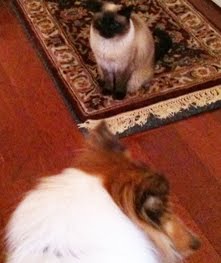
Looks like Fiona, our Siamese hacked into my blog!


I, APPLECAT ACRES FIONA CREEDON, by these presents do hereby publish this my Complaint concerning my sister Sydney.


The following constitute the major (but not all), of my beefs.


1. Why do I have to constantly shepherd my (idiot) sister? Why doesn't she know to stay where I put her?

2. Why does she try to get in MY drawer. It's not big enough for her and I claimed it first. I don't see her name on it.

3. Why does she need a leash attached to her sometimes? I know where I am going, without Mommy and Daddy having to tell me.

4. Why does she burp?

5. No self respecting animal would suck up to strangers in the shameless and undignified way she does. Doesn't she know you stay under the bed when people come over, unless they are going to give you a snack?

6. However, even if she were going to get some common sense, she is not going to stay under MY BED.

7. If I didn't torment Daddy and Mommy for food, and yell constantly for 40 minutes before our meals, and pounce on Daddy's chest knocking the air out of him, when would we ever eat? That dog would starve if I didn't do all the work to get us fed on time.

8. Why does she wag her tail when she is happy? Everyone knows you put your tail up in the air when you are happy, and swish it from side to side when you are irritated. She gets everything backwards. I think she's dyslexic.

9. Why doesn't she meow like a normal animal instead of making silly Woof sounds?

10. WHY WAS MY NINTH BIRTHDAY FORGOTTEN WHEN THERE WAS AN ICE CREAM PIE FOR SYDNEY'S EIGHTH BIRTHDAY?


Proclaimed this day, the Sixteenth of the Calends of July, in the year Anno Domini Two Thousand and Eleven, BY

APPLECAT ACRES FIONA CREEDON.
(I have an Official Registration Certificate from a nationally recognized Pure Bred Animal Association and Sydney doesn't.)


Witnessed by my minion, Daddy.